
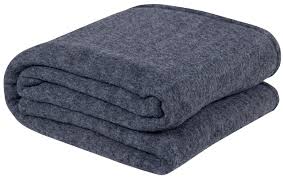
General information: -
Blankets are used to provide insulation / protection against loss of body temperature, according to the requirements imposed by climate / temperature
conditions.
Technical Specification: _
S.N. Denomination and norms Final Specifications
1. Material Minimum 80% wool material 20% other fibres (e.g. Cotton or Cotton/Synthetic mix).
2. Make Woven, dry raised both sides
3. Content, ISO 1833 On dry
weight.
1) 80% wool fibres +/-5%.
2) 20% other textile fibres+/-5%.
4. Dimensions / Size 150 x 200cm +3%/-1%. To be taken on flat stabilized sample, without folds.
5. Weight. The Weights
determined by total weight X
total surface =.
Total weight of the unit
1) Min. 850g/m²
2) 2400 to 2550 Grams
6. Thickness, ISO 5084 1 Kilopascal on 2000mm²-5mm minimum
7. Tensile strength, ISO13934-1 250N minimum warp and weft.
8. Tensile strength loss after
washing ISO13934-1 and ISO
6330.
Maximum 5% warp and weft after 3 consecutive machine washing at 30°C and one flat drying.
9. Shrinkage maxi. ISO 6330 Maximum 5% warp and weft after 3 consecutive machine washing at 30°C and one flat drying.
10. Weight loss after washing Maximum 5% after 3 consecutive machine washing at 30°C and one flat drying.
11. Thermal resistance, ISO
5085-1
Rct = 0.25m². K/W minimum, rounded to the nearest 0.01, passed on samples picked from compressed bales.
Mechanical conditioning: after opening of the bale, the blanket shall be dry tumbled in a dryer (500I minimum capacity) without
any other load for 15 minutes at a temperature of less than 30°C. Then, the blanket shall be conditioned for at least 24 hours by
flat lying at ambient conditions (20°C and 65% Relative Humidity).
12. Resistance to air flow ISO
9237 under 100Pa pressure
drop.
Maximum 1000 L/m²/s
13 Finish Whipped seam at 10mm from the edge with 10 to 13 stitches / 10cm or stitched ribbon or hemmed on 4 sides.
14. Organoleptic test 1) No bad smell, Not irritating to the skin, no dust. 4