
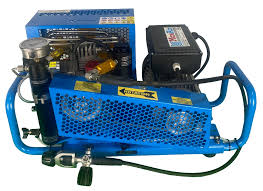
PORTABLE HIGH PRESSURE BREATHING AIR COMPRESSORS
Category: Flood Water Rescue (FWR) Equipment
Color: Red,
Size: ,
Purpose. The Portable High Pressure Breathing Air Compressor is required for charging of Air diving
Sets and storage cylinders with Breathing Air to support diving operations.
2.Functionality. The equipment should be Man-Portable and capable of charging High Pressure Breathing
air cylinders upto a working pressure of 300 bars.
PART II
OPERATIONAL CHARACTERISTICS AND FEATURES OF PORTABLE H.P AIR
BREATHING COMPRESSOR
3. Principal Components of Equipment:- The High pressure Air compressor must incorporate the
following: -
(a) Compression Unit (3-stage) with working pressure of 300 bars. Test pressure not less than 350
Bars.
(b) Diesel Driven Compressor.
(i) Drive – V belt drive.
(c) Flexible connection and charging hoses: Two outlet hoses should be provided with adaptors
for charging underwater breathing apparatus with separate vent valves.
(d) Instrumentation: All gauges and instruments supplied are to be calibrated & supplied with
calibration certificates, which would be valid during commissioning of the compressor.
Calibration procedure for all gauges is to be provided.
(e) Repair kit/Tool kit
(f) Air cooling system
(g) Test Kits if any
4. General Dimensions.
(a) The compressor should be a completely assembled unit with Compressor and Diesel engine
mounted on the same base frame.
(b) Space constraints: Ease of operation and maintenance is to be ensured while designing the
layout of the system components. The limiting dimensions for the equipment are as under and
the supplier is to indicate the parameters in the following format: -
Charging
Rate
Length
(NMT)
Breath
(NMT)
Height
(NMT)
Weight
(NMT)
Filtering
Capacity
3 – 4 cfm 90 cms 55 cms 55 cms 70 kgs 80 m3
177
5. General Features/characteristics:- The general characteristics should be as follows:-
(a) Design should be such that there is minimum wearing of components for ease of maintenance.
(b) Lubrication system should be such that air being pumped is totally safe from contamination.
No hand priming of the lubrication system is to be required.
(c) Filtration should take place throughout the system, at intake, during compression and at final
point of use to ensure highest levels of purity of gas delivered.
(d) Eco friendly condensate collection.
(e) To be user friendly for operation and maintenance.
6. Safety Features:-
(a) No running parts should be exposed.
(b) Pressure relief valves to be provided for each stage.
(c) Every reasonable and practical effort shall be made to minimize equipment noise through subassembly and component design. All parts of the equipment and accessories are to be designed
to ensure resistance to fracture distortion or misalignment due to forces of vibration.
(d) Suitable change over arrangement should be made for the compressor to deliver output pressure
equal to the test pressure, for pressure testing of the system piping after installation/ periodic
repair/testing.
7. Environmental Conditions:- The equipment should not require a controlled environment for
stowage and should bear temperature ranges of +5 to 45 °C and 90% humidity. It should withstand air
contamination through oil, salt and other contaminants.
8. Purity of air quality:- As per international standards conforming to DIN 3188/BIS/EN or equivalent
standards. The air purity standards required for discharged air are as follows: -
(i) Odour - Nil
(ii) Carbon Dioxide - less than 500 ppm
(iii) Carbon Monoxide - less than 10 ppm
(iv) Oil Contents - less than 0.0015 mg/its
(v) Moisture Contents - less than 0.5 gm/m3
(vi) Oxygen Contents - 21% plus or minus 0.5%
9. Documentation:- The following documents are to be provided:
(a) Installation, Operation, maintenance manual in English language.
(b) Equipment parts list with vendor part numbers for all spares including recommended Base &
Depot spare list for one year.
(c) Arrangement drawings.
(d) Paper particular, company part numbers with description of all components of the equipment is
to be provided.
178
PART III
MAINTENANCE
10. Maintenance and Product Support.
(a) On Board Maintenance:- All the items should afford easy maintenance, by replacement of
consumable spare parts or by way of replacement with new items. The equipment should be
supplied along with special tool kit and test equipment as required for the same.
(b) Base and Depot Spares/ Stocking:- Manufacturers Recommended List (MRL) of Base and
Depot (B & D) spares and On Board Spares (OBS) must be provided with cost. Adequacy and
continued availability of spares/ replacement of the item (depending upon the life span) must
be ensured prior to placement of orders for this equipment.
(c) Performance Monitoring:- The facility/method to determine a drop in the equipment
performance relative to the laid down standards at the time of supply should be provided.
(d) Product Support:- The OEM/ supplier should support each item of the equipment supplied, for
a period of its life span. Any obsolescence of the component/ spare/ item needs to be intimated
by the firm, well in time, to enable stocking of spares by the NDRF. The firm shouldalso
recommend/ offer suitable substitutes/ replacement for such components. In addition, upgradation/ modification to the equipment, resulting in enhancement in the performance should
be intimated and offered to the NDRF.
(e) AMC:- The firm should also indicate their willingness to undertake AMC (which would be
separate contract on expiry of the warranty period) either directly or through their authorized
Reps in India.
11. Testing Procedures:- The equipment should adhere to the environmental test conditions & proof
thereof as per International standards. The supplier should agree to trials of the equipment by the NDRF at
'No Cost No Commitment ' basis. All relevant certificates relating to HP pipes, valves, gauges, purifier
cartridge and air sample report from a Govt./ International recognised agency must be submitted.
**********